The history of Clay County, feature 1:
Some of Clay County’s most interesting places aren’t found on a main highway. They hide at the end of gravel roads, tucked among fields and trees, waiting for curious visitors to discover them. Spring Ranche is one of those places.
Today, visitors who make the journey into western Clay County will find a quiet cemetery shaded by towering cedars and a Nebraska Historical Marker standing watch over the prairie. Little remains of the community that once existed there, but the stories left behind offer a fascinating glimpse into the county’s earliest days.
While the cemetery is commonly known today as Spring Ranch Cemetery, the original settlement was known as Spring Ranche, a spelling that appears on the Nebraska Historical Marker and in historical records dating back to the community’s earliest years.
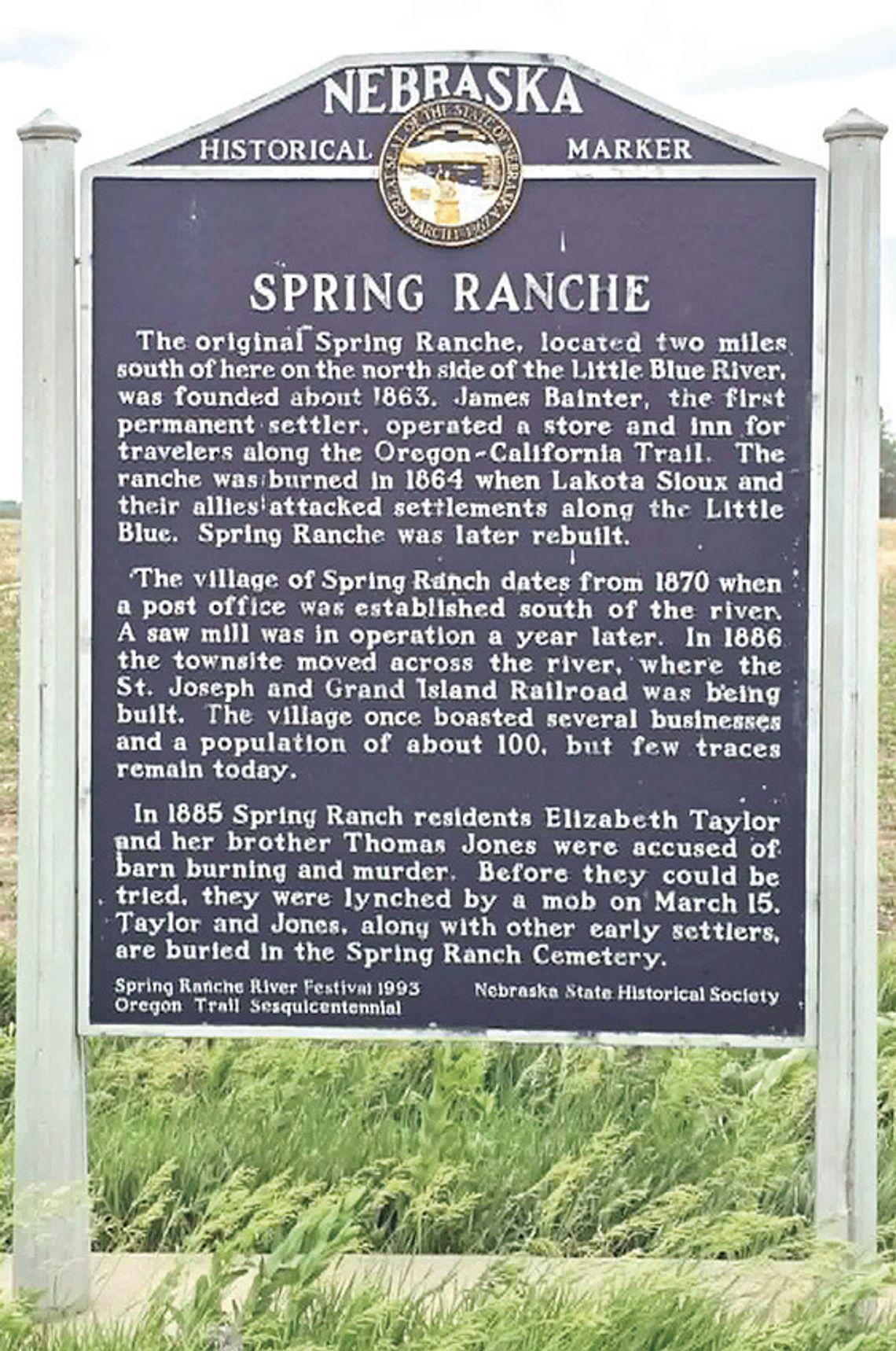
The story of Spring Ranche began in 1863 when James Painter established a ranch, store, and inn along the Little Blue River. At the time, Nebraska was still a territory, and thousands of emigrants were making their way west on the Oregon and California Trails. Painter’s ranch became an important stopping place where travelers could rest, obtain supplies, water their livestock, and prepare for the next leg of their journey.
Life on the frontier was often unpredictable. During conflicts along the Little Blue River in 1864, the original ranch was destroyed. Like many pioneers of the era, however, Painter rebuilt. As more settlers arrived in the area, a community began to grow around the ranch. A
DIANE SMITH | CLAY COUNTY NEWS
post office was established in 1870, and over the following years Spring Ranche developed into a small but active settlement with homes, businesses, a school, and the hopes of becoming a lasting Nebraska town.
Located along an important travel route, Spring Ranche occupied a strategic position during the early settlement of southern Nebraska. Before modern highways and railroads, rivers often served as guides for travelers moving across the prairie. The Little Blue River corridor became home to ranches, trading posts, stage stops, and settlements that supported westward migration and eventually attracted permanent residents.
Like many Nebraska communities, Spring Ranche’s future became tied to the railroad. When rail lines expanded across the state, towns that secured a railroad connection often prospered while others struggled. Spring Ranche shifted closer to the tracks in an effort to remain viable. For a time, the community flourished. The town appeared on maps, maintained its own post office, and served local residents and travelers alike.
Eventually, however, changing transportation routes and population shifts led to its decline. The post office closed in 1903, businesses disappeared, and residents moved elsewhere. Over time, the buildings vanished, leaving behind only traces of a community that had once been full of life.
Today, one of the best places to learn about that history is the Nebraska Historical Marker located along Road 307 near the cemetery. The marker tells the story of the visitors that this quiet stretch of prairie was once an important stop along the Little Blue River and a gathering place for early settlers carving out a life on Nebraska’s frontier.
Just a short distance away sits Spring Ranch Cemetery, perhaps the most visible reminder of the community that once existed there.
Walking among the gravestones offers a glimpse into the lives of Clay County’s earliest residents. Some markers are simple and weathered by more than a century of Nebraska wind, sun, and snow. Others are remarkably ornate, featuring intricate carvings, symbolic designs, and impressive stonework. Family names still familiar throughout the region can be found etched into the monuments.
The cemetery tells countless stories of frontier life. There are graves of settlers who helped build the community, children whose lives were cut tragically short, and veterans who carried memories of distant wars back to the Nebraska prairie. Together, the stones create a record of the people who helped shape Clay County during its earliest years.
Among those buried in the cemetery are two individuals connected to one of the most infamous episodes in county history.
In 1885, local farmer William Wolf was murdered and his barn was burned. Thomas Jones and his sister, Elizabeth Taylor, were accused of involvement in the crime. Before the case could be decided in court, a mob took the pair from jail and lynched them. The incident became one of the most controversial events in Clay County’s early history and remains a stark reminder of a time when frontier justice sometimes bypassed the legal system altogether.
Today, Jones and Taylor rest among the other graves at Spring Ranch Cemetery. Their markers continue to attract the attention of local historians interested in one of the county’s most enduring and tragic stories.
Yet Spring Ranche is about more than a single crime or tragedy.
It is the story of the settlers who arrived on an open prairie and built something from nothing. They established homes, businesses, schools, churches, and farms. They endured harsh winters, droughts, economic uncertainty, and isolation while helping create the foundation of modern Clay County.
Standing among the cedars today, it is easy to imagine what once existed here. Wagons traveled nearby trails. Children attended school. Families gathered for church services and community events. Farmers worked the surrounding land, hoping each season would bring a better future.
Most of the physical evidence of Spring Ranche has disappeared. The sounds of daily life that once filled the community have long since faded. But the cemetery, the historical marker, and the stories preserved there continue to connect modern residents with the people who came before them.
For those willing to venture down a gravel road and spend a few quiet moments among the trees, Spring Ranche offers more than a history lesson. It offers a chance to stand in a place
NEWS
where Clay County’s past still feels remarkably close.
Sometimes the most interesting stories are not found in museums or history books alone. Sometimes they are waiting at the end of a gravel road, hidden among the cedars, ready to be discovered.
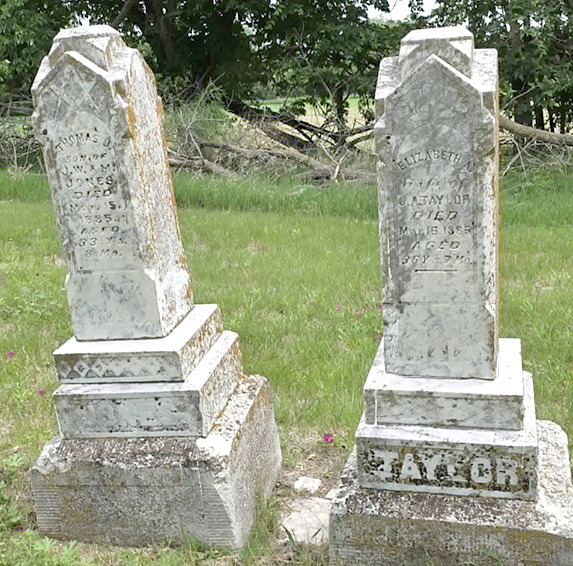
In 1885, local farmer William Wolf was murdered anDIdAN EhSiMsITHb | a CLrAnY burned. Thomas Jones and his sister, Elizabeth Taylor, were accused of involvement in the crime. Before the case could be decided in court, a mob took the pair from jail and lynched them. C OwUNaTsY
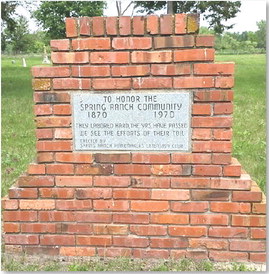
An honorary monument erected by the Spring Ranch Homemakers Extention Club stands where the original community of Spring Ranche is in southwestern Clay County. The monument was put in place in 1970. DIANE SMITH | CLAY COUNTY NEWS