You probably know who your mayor is. You may know who represents you on the Clay County Board of Supervisors. You probably know who to call when the neighbor’s dog is in your yard again.
But do you know which township you live in?
Better yet, do you know who serves on its board?
Clay County has 16 townships, and tucked quietly into each one is a small piece of local government that many residents may rarely think about. Each township has three board positions, filled by residents who live within the area they serve.
They aren’t sitting in an office at the courthouse every day. They are neighbors, farmers, landowners and other local residents traveling many of the same roads as the people they represent.
And what they do is considerably more interesting than the words “township board” might suggest.
After a Nebraska thunderstorm dumps several inches of rain, township board members may be among the first to notice that gravel has washed away or a culvert is struggling to keep up.
After a blizzard, they may know exactly which rural road always seems to drift shut.
They know which roads school buses travel, which ones farmers depend on during planting and harvest and where water tends to cause trouble after a hard rain.
They know these things for a simple reason.
They live there. That is the basic idea behind township government: putting certain local decisions and responsibilities in the hands of people who live close to the people and places affected by them.
A township is not a town The terminology can be confusing, particularly because some Clay County townships share names with familiar communities.
Sutton Township, for example, is not the same thing as the City of Sutton. Sutton has its own city government. Likewise, Clay Center is located within the area identified as Lynn Township, but Clay Center has its own municipal government.
In other words, seeing Sutton or Clay Center inside a township on a map does not mean the township board replaces or serves as the city government.
Townships are geographic political subdivisions established under Nebraska law and are particularly relevant to the rural areas surrounding the county’s incorporated communities.
More than gravel roads Roads are probably the responsibility most commonly associated with townships.
Nebraska law gives township government responsibilities involving roads and culverts. Township board members can help identify problems and communicate needs when roads wash out, snow blocks access or other problems arise.
But township authority does not stop at the end of a gravel road.
Nebraska law gives townships certain powers involving property, contracts, local expenditures and other matters. Township electors also have specific powers established by state law, including some authority concerning substances that could be harmful to township property.
That last one may sound like something only a lawyer could love, but there is a real Nebraska example of why it matters.
In Butler County, Read Township adopted regulations involving liquid livestock waste. The dispute eventually reached the Nebraska Supreme Court, which recognized authority granted to townships under state law to prohibit liquid livestock waste pipelines on township property and certain regulations designed to prevent livestock waste from reaching township property.
Townships can also have a role when certain county roads are proposed for permanent abandonment. Nebraska law provides a process through which a township can be offered the opportunity to assume responsibility for a road rather than simply see it abandoned.
Those examples help explain the phrase “local control” that often comes up when township government is discussed.
Township boards do not have unlimited authority. Their powers are established by state law, and some financial authority is subject to county oversight.
What the township system does is place another set of locally elected residents into certain decisions affecting their particular area.
Three seats, but what happens when one is empty?
Clay County’s 16 townships each have three board positions, meaning there are 48 possible township board members across the county when every position is filled.
Not every position currently is. One vacant position, however, does not mean a township board can no longer function.
Under Nebraska law, the process involving an inactive township board begins when two or more positions have been vacant for at least six months and the county has been unable to fill them.
The county board must then hold a public hearing. State law establishes additional procedures that can eventually result in the township board’s functions being performed by the county.
The distinction is important because a three-member township board can continue operating with two members.
The current makeup of Clay County’s township boards varies. Some have all three positions filled, while others have vacancies. School Creek and Marshall are currently identified as inactive on county township records provided to the Clay County News.
What does serving actually look like?
“Township board member” may not be a title that immediately sounds exciting.
But the job is about things that can become very important when they are happening outside someone’s front door.
Board members may be dealing with the road that continually washes after heavy rain, a culvert that needs attention or a rural road residents depend on for access.
Knowing the area matters. A board member who regularly travels those roads may know why an unassuming stretch of dirt road is important to a farmer, where snow tends to drift or which areas repeatedly have drainage problems.
Township boards also conduct meetings, make decisions involving township responsibilities and deal with the financial and administrative work that comes with being a governmental body.
It is local government on a very small scale.
How can residents participate? Residents who are curious about township government can start with a simple question: Which township do I live in?
From there, they can find out who serves on their township board and when it meets.
Township meetings are public meetings, giving residents an opportunity to see what their board is working on, hear discussions and bring concerns to the people representing their area.
Residents interested in serving can also find out whether their township has a vacant position and learn about the requirements for township office.
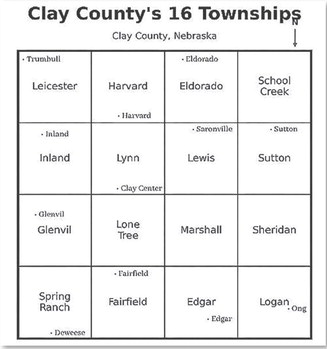
Clay County’s 16 townships divide the county into smaller areas of local government. Each township can have a three-member board responsible for duties established under Nebraska law. Incorporated communities are shown for reference.
The Clay County Election Office can help residents determine which township they live in and provide information about township offices, vacancies and election filing requirements.
The office can be reached at 402-762-3463 or [email protected].
Why talk about townships now?
There is a reason this little-known layer of local government is receiving more attention.
The Clay County Board of Supervisors voted 5-2 Tuesday to place the question of discontinuing township organization on the November ballot. Clay County voters rejected a similar proposal in 2024.
Between now and Election Day, voters will hear arguments about whether township governments continue to serve an important purpose or whether its responsibilities could be handled more efficiently by county government.
Those questions will be explored separately.
For now, residents who have never given much thought to township government have an opportunity to learn more about the system already in place.
Find out which township you live in. Learn who serves on its board. Attend a meeting if you are curious about what happens there.
If serving in local government interests you, find out what township positions are available and what the job involves.
And when the question appears on the ballot this fall, voters will have something more valuable than an argument from either side.
They will know what they are voting on.