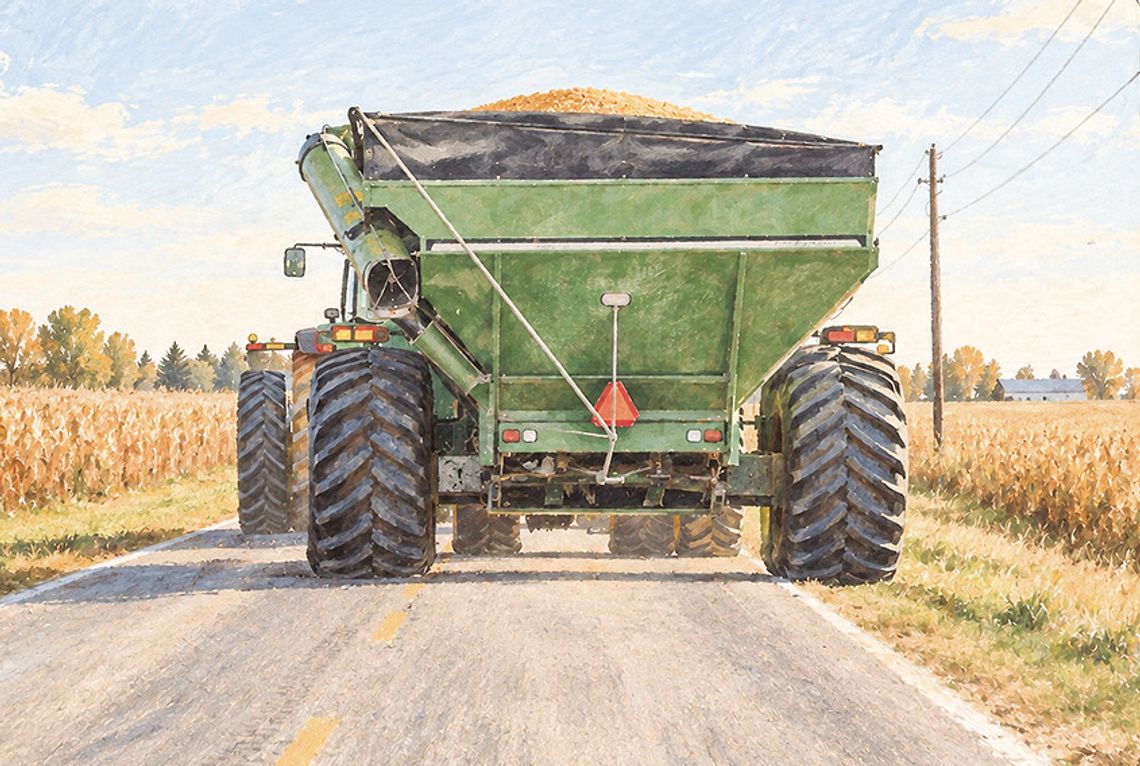
As harvest approaches, drivers throughout Clay County can expect to encounter more combines, tractors, grain carts and trucks traveling between fields, farms and grain elevators.
The increase in slow-moving equipment is a familiar part of fall in an agricultural community, but it requires additional attention from motorists.
Large farm equipment travels considerably slower than most other vehicles. A driver traveling at highway speed may close the distance between a vehicle and a piece of equipment more quickly than expected, leaving little time to react.
Farm machinery may also be wider than a single lane and difficult to move onto the shoulder. Mailboxes, bridges, road signs, ditches and soft ground can require an operator to remain near the center of the road.
An equipment operator may move to the right before making a wide left turn into a field or driveway. That movement should not automatically be interpreted as an invitation to pass.
Drivers should wait until they have a clear view of the road ahead before attempting to go around farm equipment. Hills, curves and intersections can hide approaching vehicles, while dust from fields and gravel roads may further reduce visibility.
Large equipment also has blind spots, particularly behind the machine. Leaving additional space gives the equipment operator a better opportunity to see surrounding traffic and gives other drivers more time to respond if the machine slows or turns.
Extra caution may be needed near grain elevators as truck traffic increases. Drivers may encounter trucks entering or leaving elevator property, waiting along nearby roads or moving more slowly while carrying a full load.
Harvest activity frequently continues after dark when weather and field conditions allow. Although farm equipment uses lights, reflective markings and slow-moving vehicle emblems, its size and speed can still be difficult to judge at night.
National Farm Safety and Health Week will be observed Sept. 21 through 25. The annual observance has taken place during the third week of September since 1944, coinciding with one of the busiest times of the agricultural year.
This year’s observance includes a focus on equipment and rural roadway safety, along with farmer health, multiple generations working in agriculture, confined spaces and cancer prevention.
The safety campaign recognizes that rural roadways are shared by motorists, farm equipment operators, school buses, bicyclists and pedestrians. Each may travel at a different speed and have a different view of surrounding traffic.
Harvest also changes ordinary traffic patterns. Equipment may enter a road from a field rather than a marked intersection, and trucks may turn into locations that are not normally busy during the rest of the year.
Allowing additional travel time can reduce the temptation to pass when visibility or space is limited. A short delay behind farm equipment generally lasts only until the operator reaches the next field or finds a safe place to allow traffic to pass.
As corn and soybeans reach maturity, harvest traffic will become more common across Clay County. Slower speeds, increased following distance and patience when approaching farm equipment can help everyone using the roads reach their destinations safely.