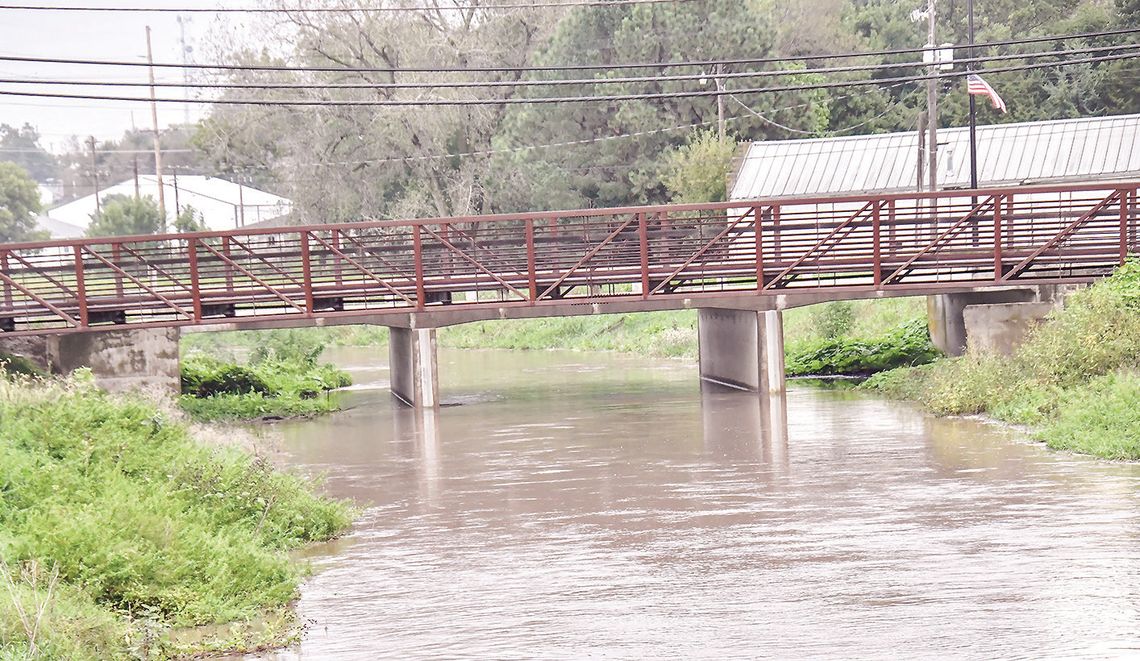
Heavy rainfall across Nebraska brought flooding concerns to Clay County this week, including rising water along the Little Blue River near Deweese, as Gov. Jim Pillen declared a state of emergency in response to severe flooding across southeast Nebraska.
The National Weather Service in Hastings issued a Flood Warning Wednesday evening, Sept. 30, for the Little Blue River near Deweese, affecting Clay and Nuckolls counties. The warning was part of a larger weather event that brought significant rainfall to portions of Nebraska and surrounding states.
Farther east, record-setting rainfall overwhelmed roadways and drainage systems, leaving motorists stranded and prompting emergency water rescues.
Lincoln officially recorded 6.15 inches of rain Sept. 30, breaking its previous single- day rainfall record of 5.45 inches, which had stood since Aug. 29, 1910.
On Thursday, Oct. 1, Pillen joined representatives of the Nebraska Emergency Management Agency (NEMA), Nebraska National Guard, Lancaster County and Lower Platte South Natural Resources District to survey flooding in northern Lancaster County. During the visit, he signed an emergency proclamation authorizing additional state-level response.
But what does declaring a state of emergency actually mean for Nebraska communities?
Under Nebraska’s Emergency Management Act, a governor’s emergency declaration allows the state to coordinate and provide additional resources when a disaster exceeds, or threatens to exceed, the ability of local governments to respond using their own personnel, equipment and funding.
Rather than leaving individual counties and municipalities to manage a largescale emergency independently, the declaration provides a framework for coordinating assistance through NEMA and other state agencies.
Depending on the circumstances and identified needs, that assistance can include additional emergency personnel, equipment, logistical support, damage assessment teams and other resources necessary to protect public safety and restore essential services.
The declaration also allows the governor to authorize expenditures through the Governor’s Emergency Program when the financial demands of a disaster place an unreasonable burden on existing state or local resources.
For example, a community facing extensive flood damage to public roads, bridges, drainage systems or other essential infrastructure may be eligible to request state assistance if the financial burden exceeds its ordinary capacity. Such assistance is subject to application, review and approval rather than being automatically distributed.
The declaration does not, however, mean that federal disaster assistance is immediately available to every homeowner, farmer or business affected by the flooding.
A state emergency declaration and a federal disaster declaration are two separate actions.
If damage assessments demonstrate that the disaster exceeds Nebraska’s available resources and meets applicable federal requirements, the governor may request a presidential disaster declaration through the Federal Emergency Management Agency (FEMA).
Depending on what is ultimately approved, federal assistance could include funding to help communities recover eligible emergency response costs, repair damaged public infrastructure or provide assistance to qualifying individuals and households. According to the Governor’s Office, NEMA is already coordinating with FEMA, the Small Business Administration (SBA) and the Natural Resources Conservation Service (NRCS) as damage assessments continue. Those findings will help determine what additional assistance may be available to affected residents, businesses and communities.