What makes Sutton Public Schools special, and what will students need from their school in the years ahead?
Those questions brought community members together Oct. 22 for a conversation about the district’s future. Participants shared what they value about their school, where they see challenges and how the school and community can continue helping each other thrive.
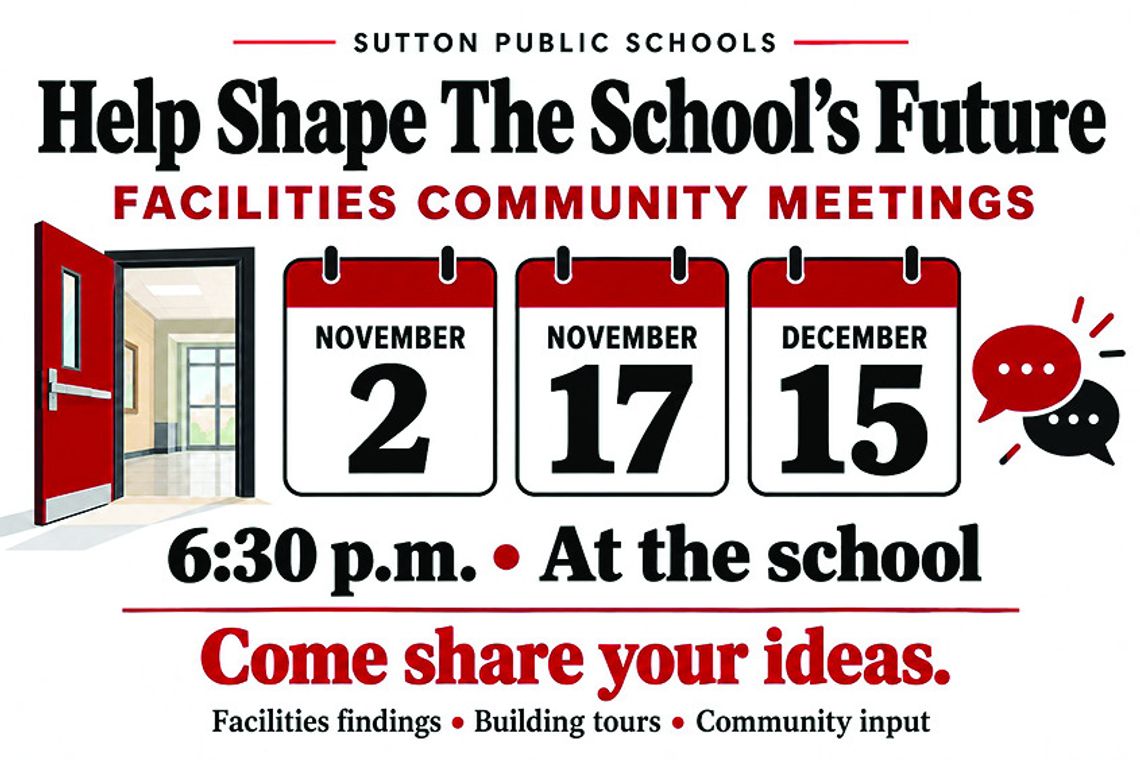
The discussion was part of the Sutton Board of Education’s effort to develop a fiveyear strategic plan. A related facilities planning process will give residents more opportunities to take part, with community meetings scheduled for Nov. 2, Nov. 17 and Dec. 15 at 6:30 p.m. at the school.
During the October discussion, representatives of the Nebraska Association of School Boards guided participants through questions about district strengths, future challenges, community partnerships and priorities.
A recurring theme was the connection between the school and the people who call Sutton home.
Participants spoke about graduates returning to raise their own families, local businesses stepping forward when help is needed and residents giving generously to support students.
They also described a school where newcomers are welcomed and students with special needs are included. Connections among younger and older students, along with having kindergarten through high school under one roof, were identified as strengths.
That sense of community extends beyond the school doors.
Participants pointed to students visiting the nursing home, volunteering and completing construction class projects benefiting the Bread Box as examples of students learning while giving back.
The conversation also looked at what it will take to preserve those strengths while meeting changing needs.
Although participants expressed pride in the school, they identified significant questions about classroom space, accessibility, safety and the building’s ability to support today’s educational needs.
Accessibility is a major concern as the district considers its facilities, including evaluating Americans with Disabilities Act (ADA) compliance and identifying barriers for people with disabilities. That work affects students and staff, as well as parents, grandparents and other visitors attending school activities.
The planning process provides an opportunity to examine those needs and consider improvements that allow everyone to participate in school life. The discussion did not establish specific ADA violations or identify which improvements would be required.
As programs and educational approaches change, participants said, the spaces used for learning also need to keep up.
Teacher recruitment and retention were discussed, along with preparing for future staff shortages. Housing and child care availability were identified as community concerns that can affect whether prospective employees are able to make Sutton their home.
Enrollment was another topic. District administration said student numbers had generally ranged from about 395 to 410 over the past five to 10 years. Participants also spoke about younger families and children approaching school age as encouraging signs for the community’s future.
Preparing students for life after graduation drew considerable interest.
Participants supported strengthening career pathways, internships, work release and job shadowing through relationships with local businesses and people working in the trades.
The discussion recognized that students have different talents and ambitions. Some will pursue four-year degrees, while others may attend trade school, enter the workforce or eventually open businesses of their own.
Participants praised existing career activities, practical financial education and opportunities to earn college credit while still in high school. They encouraged the district to continue building experiences that help students understand their choices and find a direction that fits them.
Community members also suggested bringing more local expertise into classrooms and helping teachers build stronger connections with students’ families.
Several participants said school communication and transparency had improved in recent years. “Coffee with Cline” was mentioned as a welcome opportunity to ask questions and learn more about district decisions.
The discussion also acknowledged the need to weigh improvements carefully against their cost. One participant asked the district to consider the effect of spending increases on property owners, including those living on fixed incomes.
When asked to identify a few priorities for the next five years, participants returned to facilities—including accessibility and safety—career preparation and staffing, along with keeping pace with changes in education.
Those ideas will become part of a larger review of survey responses and community feedback. Facilitators said that information will help identify needs and shape recommendations for district administration and the school board. No final priorities or facility improvements were approved during the discussion.
The upcoming facilities meetings offer another chance for residents to help shape that work.
According to the district’s community invitation, the board hired BVH to conduct an initial facilities audit, examining the building and its systems and meeting with staff about how well the spaces support current educational needs.
BVH will present its findings, listen to community feedback and conduct guided building tours during the meetings.
Parents, grandparents, graduates, business owners and residents who do not currently have children in school all have a perspective to contribute. The meetings will be held in an informal setting to encourage questions and open conversation.
Community members are encouraged to attend Nov. 2, Nov. 17 and Dec. 15 at 6:30 p.m. at the school, take a look around and join the discussion about what comes next for Sutton students.